Start
Passerelle

<strong>Passerelle</strong> is a high-performance host-guest shared filesystem driver for <strong>QNX® Neutrino® 8.0</strong> virtual machines under QEMU, providing seamless directory sharing via <strong>9P2000.L</strong> and <strong>virtiofs</strong> over modern virtio-PCI and virtio-MMIO.
Submitted to the <strong>QNX Global Hackathon 2026</strong> under the Apache-2.0 license.
Why Passerelle?
Developing software for QNX virtual machines today usually means suffering a slow iteration loop:
[Host] cross-compile ──> [SCP / rebuild disk image] ──> [Guest] boot / transfer ──> [Guest] test runEvery change pays a "copy tax". If the VM image is read-only or minimal, you must regenerate the entire image just to test one binary.
With Passerelle, your build directory on the host PC is mounted directly inside the QNX guest:
[Host] cross-compile ──> [Guest] run immediately from /hostBinaries execute straight from the share, shared libraries load on demand, and files created or modified by QNX are instantly available on the host.
Prior Art & What Passerelle Adds
In accordance with open-source engineering ethics and hackathon standards, Passerelle explicitly acknowledges prior art. Two public 9P clients and one virtio transport library exist for QNX:
- **`gvergine/qnx-fs-9p`** (October 2026, Apache-2.0): A feature-rich 9P2000.L client designed for everyday development, but **strictly restricted to ARM64 guests** over virtio-mmio. It does not support x86_64 and has no PCI transport.
- **`eclipse-score/qnx_unit_tests` (`virtio9p`)** (March 2026, Apache-2.0): Supports both x86_64 (PCI) and ARM64 (MMIO), but is **intentionally stripped down to test runner needs**: no symbolic links, no permission or ownership changes (`chmod`/`chown`), no timestamp updates, no file locking.
- **`kodebooth/qnx-virtio`** (April 2026, MIT): A transport library for virtio on QNX 8.0 with a sample GPIO driver, but no filesystem implementation and no host-side testability.
What Passerelle Adds
| Capability | qnx-fs-9p (A) |
qnx_unit_tests (B) |
<strong>Passerelle</strong> |
|---|---|---|---|
| <strong>Full x86_64 Guest Support</strong> (PCI modern, MSI-X) | ❌ <em>ARM64 only</em> | ⚠️ <em>Minimal ops only</em> | <strong>Target: complete POSIX share</strong> |
| <strong>Full ARM64 Guest Support</strong> (MMIO v1 & v2) | ✅ Yes | ⚠️ <em>Minimal ops only</em> | <strong>Target: complete POSIX share</strong> |
| <strong>POSIX Operations</strong> (symlinks, chmod, chown, utime, df) | ✅ Yes | ❌ No | <strong>Target: yes (redirect symlinks, atomic renames)</strong> |
| <strong>virtiofs for QNX Guests</strong> (FUSE over virtio) | ❌ No | ❌ No | <strong>✅ Target (X tier)</strong> — no public implementation found |
| <strong>Real-Time Priority Scheduling</strong> | ❌ FIFO | ❌ Unspecified | <strong>Target: priority-ordered dispatch</strong> |
| <strong>Host PC Testability without QNX SDP</strong> | ❌ Needs SDP | ❌ Needs Bazel/SDP | <strong>✅ Portable L1/L2/L3, PC unit tests</strong> |
| <strong>Differential Conformance Testbed</strong> | ❌ Trace-only | ❌ None | <strong>✅ Harness written</strong> (host/fsproof, 1M-op target) |
<strong>One-Command Setup CLI</strong> (qshare) |
❌ Manual QEMU | ❌ Manual script | <strong>✅ qshare tool written</strong> |
<strong>Reading this table honestly.</strong> The "Passerelle" column states what the project <em>provides by design and targets</em>; the columns for projects A and B state what their code and documentation show today. Implementation status per requirement — including what is not yet done — is in docs/verification-status.md. The absence of a public QNX virtiofs guest driver is a <strong>search result, not a proof</strong> (spec §14).
See docs/state-of-the-art.md for detailed code-level analysis and NOTICE for project attributions.
Architecture
Passerelle follows a modular three-layer design:
  QNX Applications: open, read, write, stat, readdir, execve...
        │  QNX Messages handled at caller priority (QNX-03)
 ┌──────▼────────────────────────────────────────────────────────┐
 │ Layer 3 — Filesystem Resource Manager (`rmfs/`)               │
 │   Path namespace, fids/inodes, permission checks (SEC-01),     │
 │   guest-local range locks (FS-14), priority scheduler (QNX-04)│
 ├──────────────────────────────┬────────────────────────────────┤
 │ Layer 2 — 9P2000.L Protocol  │ Layer 2 — FUSE Protocol        │
 │ (`proto9p/`)                 │ (`protofuse/` - virtiofs)      │
 │ Pure C11, strict decoders    │ Pure C11, node refcounts       │
 ├──────────────────────────────┴────────────────────────────────┤
 │ Layer 1 — virtio Transport (`virtio/`)                        │
 │   Split virtqueue, indirect descs (VIO-08), zero-copy (VIO-07) │
 │   Backends: PCI Modern (x86_64), MMIO v1/v2 (ARM64), PC Mock  │
 └──────┬────────────────────────────────────────────────────────┘
        │
   QEMU: `virtio-9p-pci` / `virtio-9p-device`  or  `virtiofsd`
        │
   Host Workstation Directory
See docs/architecture.md for full design documentation.
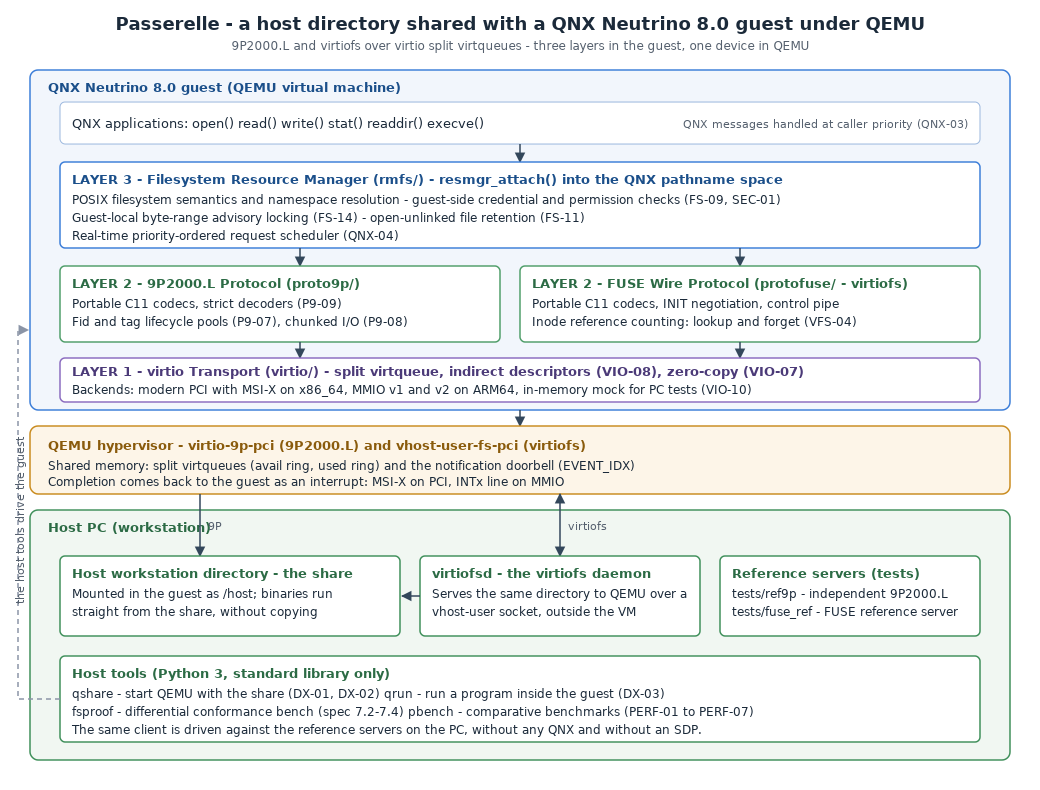
The picture is the README version of the design: three layers inside the guest (resource manager rmfs/, wire protocols proto9p/ and protofuse/, virtio transport virtio/), one QEMU device band underneath, and the host directory on the other side — plus the host tools (qshare, qrun, fsproof, pbench) and the reference servers that drive the same client without QNX.
One-Command Demo
On the host workstation (tooling status: see verification-status.md):
# 1. Share your project directory and start the VM
qshare ~/my-project

# 2. Inside the QNX VM, the host folder is mounted at /host
ls -la /host

# 3. Cross-compile on the host, run in QNX with zero copying
make -C ~/my-project
/host/bin/my_program
See docs/user-guide.md for mount options, troubleshooting, and CMake/Rust workflows.
Building
Passerelle targets <strong>QNX SDP 8.0</strong> (x86_64le and aarch64le) and builds natively on Linux for PC testing.
1. Build on Host PC (Portable Layers & Unit Tests, No SDP Needed)
The transport abstraction, protocol codecs, and resource manager core are 100% portable C11 and run directly on your Linux host:
# Standard build and CTest execution
cmake -B build -DPGW_MODULES="common;virtio;proto9p;protofuse;rmfs"
cmake --build build -j8
ctest --test-dir build --output-on-failure

# Build with AddressSanitizer and UBSan
cmake -B build-asan -DPGW_SANITIZERS=ON
cmake --build build-asan -j8
ctest --test-dir build-asan --output-on-failure
2. Cross-Compile for QNX 8.0
Requires QNX SDP 8.0. Source the SDP environment, then use the toolchain file shipped with the SDP (no repository-local toolchain wrapper exists yet — see docs/building.md):
source ~/qnx800/qnxsdp-env.sh

# For an x86_64 guest
cmake -B build-qnx-x86 \
      -DCMAKE_TOOLCHAIN_FILE="$QNX_HOST/usr/cmake/QNXToolchain.cmake" \
      -DCMAKE_SYSTEM_PROCESSOR=x86_64
cmake --build build-qnx-x86 -j8

# For an aarch64le guest
cmake -B build-qnx-arm \
      -DCMAKE_TOOLCHAIN_FILE="$QNX_HOST/usr/cmake/QNXToolchain.cmake" \
      -DCMAKE_SYSTEM_PROCESSOR=aarch64le
cmake --build build-qnx-arm -j8
Detailed step-by-step instructions and test level runner commands are available in docs/building.md.
3. Install the package, use it from another project
The portable stack can be installed into a prefix and consumed by another CMake project or by any build that speaks pkg-config:
cmake -B build -DCMAKE_INSTALL_PREFIX=/usr/local
cmake --build build -j8
cmake --install build

# downstream, with CMake
find_package(Passerelle REQUIRED)
target_link_libraries(my_app PRIVATE Passerelle::pgw_common)

# downstream, with pkg-config
cc $(pkg-config --cflags passerelle) app.c $(pkg-config --libs passerelle)
tests/install proves it end to end on every build: the tree is installed into a throwaway prefix, then a small consumer is built from that prefix with pkg-config and with find_package(Passerelle), and runs.
4. Supply chain: SBOM, provenance, coverage badge
- **SBOM** — `python3 tools/sbom/generate_sbom.py --output passerelle.sbom.json` writes a CycloneDX 1.5 document listing the real inputs (the C sources with their SHA-256, the version, the toolchain, the git commit) and states explicitly that the shipped artefact depends on no third-party library. The build provenance (compiler, flags, build type, commit, dirty state) goes to the companion file.
- **Coverage badge** — the badge at the top of this file is written by the `coverage` job of [`.github/workflows/quality.yml`](.github/workflows/quality.yml) from the gcov measurement of the production C code, and committed with its record (`docs/_assets/coverage.json`). `tools/quality/coverage_badge.py --check` fails the build when the badge does not match its record or when the measurement is too old: a badge that lies is worse than no badge.
Honest Verification Status
Every requirement is tracked against automated testing, and this README only claims what a command in this repository actually proves. What still needs a QNX SDP or a QNX guest is said so explicitly.
- **Unit & codec layers (level 0)** — implemented and green on the host PC for every portable layer: `common`, `virtio`, `proto9p`, `protofuse`, `rmfs` and the portable half of `drivers` (`ctest --test-dir build`). The QNX-only glue is compiled on the PC against `tests/qnx-stub` (job `qnx-syntax`), which proves it parses and type-checks, not that it runs.
- **Randomized input (level 1)** — `tests/fuzz` runs deterministic seeded campaigns against every wire decoder, in CI, under ASan+UBSan (`fuzz_p9`, `fuzz_fuse`). Measured out of CI: **5 000 000 iterations per decoder family, zero defect** — 11 s (9P) and 10 s (FUSE) in a normal build, 21 s and 18 s under sanitizers.
- **Differential conformance (level 2)** — `tests/e2e` replays seeded random operation suites through `pgw_rmfs` and compares every result with the PC folder, which is the truth (`test_diff`, plus the directed cases of spec 7.4 in `test_directed`). A divergence is automatically reduced to the shortest prefix that reproduces it. `host/fsproof` runs the same method against a real guest. Measured out of CI: **3 000 000 operations (3 seeds × 1 000 000), zero divergence**, in 60 s — the spec 7.6 "complete" threshold.
- **Host-side integration (E5)** — `tests/qemu` boots a minimal Linux guest on the exact options `qshare` emits and exchanges files both ways, for **9P and virtiofs**: feasibility test **E5 passed**, in 9 s per protocol ([docs/verification-status.md](docs/verification-status.md) §3.1).
- **A real QNX guest, and what it sees** — `tests/qemu/qnx71` boots QNX Neutrino **7.1.0** x86_64 on this PC with our `virtio-9p-pci` device attached. Its own `pci-tool` reports the device as `1af4:1009` with the MSI-X capability plus the five virtio vendor capabilities and three assigned BARs, and reports **no interrupt routed** to it — which is the actionable half of E1 ([EVIDENCE.md](tests/qemu/qnx71/EVIDENCE.md)). It has no compiler, so this says nothing about our driver yet.
- **Performance (level 3) and guest-side robustness (level 4)** — the harnesses are written (`host/bench`, `host/fsproof`). The **Linux reference baseline** of spec 7.5 is published in [docs/measurements/](docs/measurements/) (822 requests, round-trip table from a real QEMU 8.2 trace on an active guest). The numbers for our own QNX driver require a QNX guest and are **not** measured yet.
- **Feasibility tests E1–E4** — blocked on the QNX SDP (issues #2 to #6). E5 is done.
- **No QNX-side requirement is claimed as verified**: no QNX SDP is installed on the machine that produced this tree, and no public SDP 8.0 could be pulled without an account (the community image that ships one, `ghcr.io/kodebooth/qnx-sdp`, is private).
See docs/verification-status.md for the full matrix and docs/measurements/ for the numbers.
Documentation Index
- [docs/spec-en.md](docs/spec-en.md) — Complete English Specification (Requirements VIO, P9, FS, QNX, PERF, ROB, SEC, DX, VFS, SRV)
- [docs/spec-fr.md](docs/spec-fr.md) — Original French Specification (authoritative text)
- [docs/glossary.md](docs/glossary.md) — English glossary of every term (9P, virtio, FUSE, QNX, host tools), with the French equivalent and the source of each term
- [docs/architecture.md](docs/architecture.md) — Detailed Three-Layer Design & Tricky Issues Resolution
- [docs/user-guide.md](docs/user-guide.md) — User Guide, Mounting Options, CMake and Rust Workflows
- [docs/state-of-the-art.md](docs/state-of-the-art.md) — Comprehensive Analysis of Existing Projects
- [docs/decisions.md](docs/decisions.md) — Architectural Decisions Log (D1–D4)
- [docs/verification-status.md](docs/verification-status.md) — Honest Requirements & Feasibility (E1–E5) Status
- [docs/building.md](docs/building.md) — Compilation, Toolchain, and Test Runner Guide
- [docs/video-script.md](docs/video-script.md) — 3-Minute Hackathon Video Script
- [docs/ci.md](docs/ci.md) — Self-Hosted CI Infrastructure & 5-Minute Budget Guard
Repository CI
This repository uses a self-hosted CI pipeline on dedicated Dell PowerEdge R630 workers enforcing strict C11 compliance, AddressSanitizer verification, a <strong>5-minute maximum runtime budget per job</strong>, and automated merge queues via Mergify. Details are documented in docs/ci.md.
License & Attribution
Passerelle is distributed under the <strong>Apache License, Version 2.0</strong>. See LICENSE for full legal text and NOTICE for third-party project attributions.